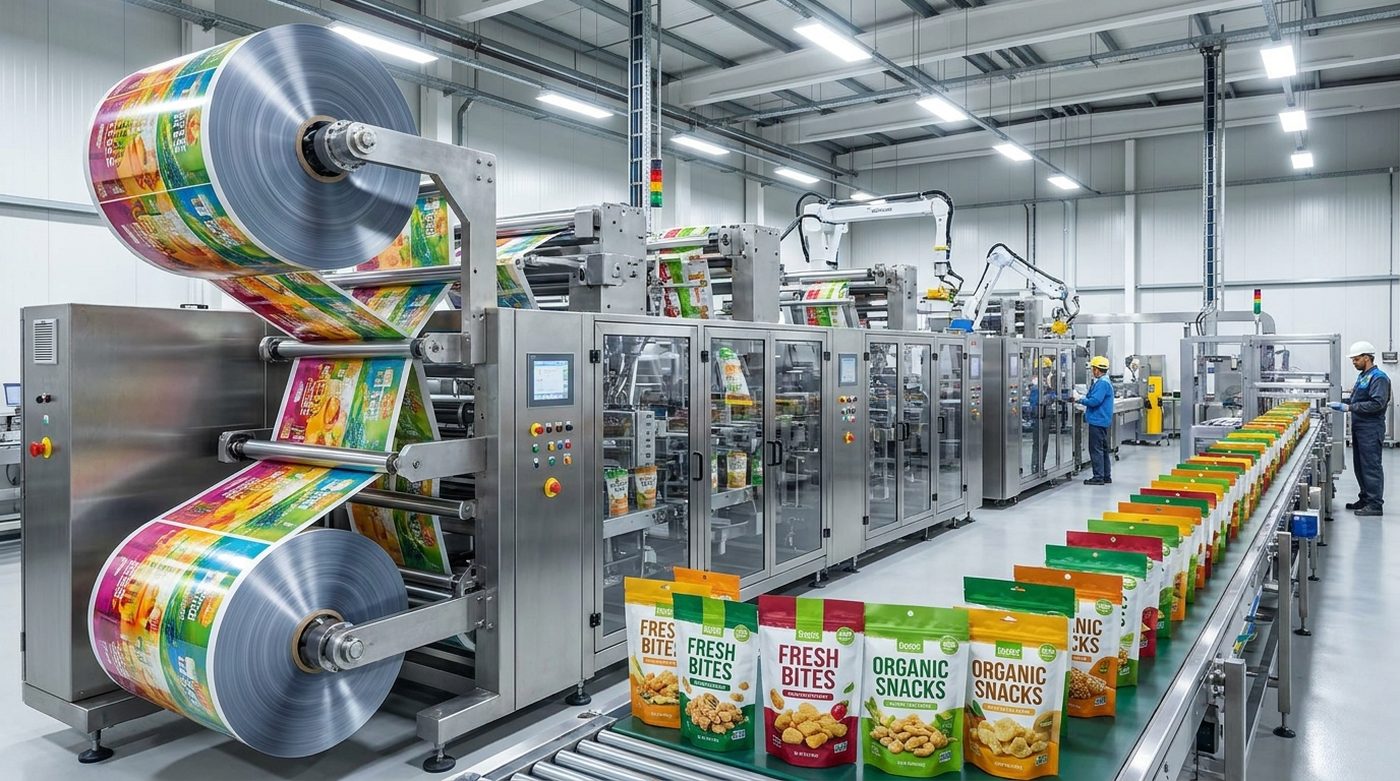
Having a wide range of masterbatch and additive products for the dynamic and rapidly changing needs of the packaging industry, Colorex develops advantageous solutions for flexible and rigid packaging applications. We produce high-performance formulas fully compatible with different production processes and polymer types widely used in the sector such as film extrusion, blow molding, and injection. We meticulously meet international food contact compliance standards (FDA, REACH) and low migration values, which are of vital importance especially in food and medical packaging.
In addition to our colored masterbatches with high opacity and gloss that extend shelf life and increase the shelf appeal of the product; we offer functional additives that closely follow innovative sectoral trends. With our oxygen barrier (scavenger) additives that prevent oxidation of food products and antimicrobial masterbatches that elevate hygiene to the highest level, we extend the life of not only the packaging but also the product inside.
We provide cost and time savings to packaging manufacturers with our special process additives such as slip, clarifier, antifog, and antistatic that maximize speed in production lines. Furthermore, we shape the future of the sector with our laser marking additives that offer ink-free coding for modern traceability needs and eco-friendly masterbatch solutions fully compatible with recycling, supporting the circular economy.
Recommended Dosage
In flexible packaging and thin film applications: 1.0% - 2.5%
In rigid packaging, bottle, and injection molding processes: 1.5% - 3.0%
In special packaging requiring food contact compliance and barrier properties: 2.0% - 4.0%
Frequently Asked Questions and Solutions
A technical guide of 50 questions compiled from the field experience of the Colorex engineering team.
Which masterbatch is safe for food packaging?
Low-migration, heavy-metal-free Colorex food-grade series compliant with EU 10/2011, FDA and REACH; formulations that do not alter the taste, odor or composition of the food should be used.
How is glass-like clarity achieved in transparent packaging?
With transparent masterbatch containing a nucleating agent/clarifier; the haze value of PP/PE is minimized to provide glass-level transparency.
Why do micro-holes (pinholes) form in thin films (BOPP/CPP)?
This is caused by TiO2 agglomeration; a high-dispersion, fine-particle-size titanium masterbatch provides agglomerate-free distribution and a smooth surface.
How is blocking (sticking) prevented in packaging film?
With antiblock masterbatch; the silica-based additive creates micro-roughness on the film surface, preventing the layers from sticking to one another.
The films are slipping/not opening on the machine during bag production?
The coefficient of friction is high; adding slip masterbatch lowers the COF and increases the packaging line speed.
How is light protection provided in milk and oil packaging?
With high-TiO2-content opacifying masterbatch; UV and visible light transmission is reduced to zero, extending the shelf life of the contents.
How is the risk of color migration (bleeding) reduced in food film?
By using high-molecular-weight, low-migration pigments (e.g. PY151); color transfer to the food is prevented.
How is odor (originating from rPCR) removed from packaging?
With odor-absorbing masterbatch; VOC and aldehyde/amine-based molecules are trapped through chemical neutralization to obtain an odorless product.
Why is the strength low in garbage bags/industrial bags?
The filler/pigment dispersion is poor; a masterbatch with homogeneous distribution that preserves tensile and puncture strength should be selected.
Why do streaks (die lines) occur in packaging film?
Die contamination or coarse particles; resolved with a clean die, a suitable filter and a high-purity masterbatch.
How is antistatic packaging (for electronics) produced?
With antistatic masterbatch; surface resistivity is lowered to prevent dust attraction and static discharge, protecting sensitive electronics.
How is whiteness and opacity increased in food containers?
With white masterbatch containing high TiO2 (50-80%); absolute opacity and bright whiteness are achieved at low dosage.
How is the UV resistance of packaging film increased?
With UV stabilizer (HALS) masterbatch; color fading and embrittlement are delayed in packaging stored outdoors.
How is color homogeneity ensured in bottle (blow molding) production?
With high-dispersion masterbatch and correct dosage; uniform color and a smooth surface are obtained throughout the bottle wall thickness.
Is coloring possible for biodegradable packaging?
With PLA/PBAT-compatible biopolymer masterbatch; environmentally friendly color solutions are offered while EN 13432 compostability is preserved.
Why is a gel (fish-eye) defect seen in packaging film?
Burnt polymer or coarse gel; prevented with a controlled process, a clean filter and a gel-free masterbatch.
How is a metallic/pearlescent packaging effect achieved?
With special effect masterbatch (pearlescent/metallic); an aesthetic shimmer is provided for luxury packaging and cosmetics.
How is layer compatibility ensured in multilayer film?
With masterbatch carried in a carrier suited to each layer's polymer; delamination and color shift are prevented.
What is the safety regulation for toy packaging?
Compliance with EN-71, EU 10/2011, REACH and RoHS; heavy-metal-free, safe Colorex series should be used.
What should the packaging masterbatch dosage generally be?
1-4% depending on the application; low for thin film, higher for opacifying/colored applications, adjusted according to the TDS.
Is cling in stretch film affected by coloring?
The wrong additive impairs cling; a cling-compatible special masterbatch that does not alter surface energy should be selected.
How is the carbon footprint reduced in packaging?
With recycled (PCR) polymer-compatible masterbatch and biopolymer series; sustainable production is supported.
How is a gray/dirty tone corrected in rPCR packaging?
With toner and opacifying masterbatch; a neutral base is created so that the target color is achieved cleanly.
Which pigment is used in food-contact black packaging?
Food-compatible, low-PAH carbon black masterbatch; standard blacks may not be suitable for food contact.
How is optical brightness increased in packaging film?
With optical brightening agent (OBA) masterbatch; yellowing is masked to provide a brighter white perception (food compliance must be checked).
Why do flow marks occur in injection-molded container production?
This is a dispersion or mold temperature issue; resolved with a homogeneous masterbatch and optimized mold temperature.
Is antimicrobial protection necessary in packaging?
Yes for hygiene-critical food containers; a silver-ion-based, ISO 22196-compliant antimicrobial masterbatch can be used.
The color lightens as the film thickness decreases, what is the solution?
Color strength must be balanced with dosage; in thin film, the target color depth is maintained with a more concentrated masterbatch.
Why is the carrier polymer important in packaging masterbatch?
PE carrier for PE film, PP carrier for PP; incompatibility creates gels, haze and mechanical weakness.
Is the barrier property impaired by coloring in vacuum packaging?
Yes, if a suitable additive is not selected; oxygen/moisture permeability is preserved with a barrier-compatible masterbatch.
How is color matching (brand color) guaranteed in packaging?
With a spectrophotometer and tight ΔE tolerance; the brand color is produced consistently by measuring every lot.
How is scrap reduced on a high-speed film line?
With low-FPV, clean masterbatch; filter clogging and downtime are reduced, lowering scrap.
Why does heat-related yellowing occur in packaging?
This is thermo-oxidative degradation; the melt is stabilized with an anti-oxidant-additive masterbatch to prevent yellowing.
Based on what is the migration test performed in food packaging?
With the relevant food simulants within the framework of EU 10/2011; Colorex low-migration series meet these criteria.
Why do white specks appear in packaging film?
Contamination or poor distribution; resolved with a high-purity, well-dispersed masterbatch.
How is color consistency ensured in colored closures?
With injection-compatible, heat-stable masterbatch; the color difference from mold to mold is minimized.
Can fluorescent warning colors be used in packaging?
Yes, with fluorescent masterbatch; however, since light fastness is limited, they are suitable for short-shelf-life applications.
Does crystallization in a PET tray affect coloring?
If a suitable pigment is not selected, haze increases; a PET-compatible masterbatch that does not disrupt crystallization should be preferred.
How should packaging masterbatch be stored?
In a cool, dry environment, in its original packaging; moisture-absorbing carriers should be dried before production.
What happens when the TiO2 ratio is increased in thin packaging?
Opacity increases, but in excess a risk of embrittlement and pinholes arises; the optimum concentration is selected according to the TDS.
Why do layer thickness fluctuations occur in packaging film?
Feeding or melt inhomogeneity; stabilized with gravimetric dosing and low-FPV masterbatch.
How is a luxury appearance achieved in cosmetic packaging?
With metallic, pearlescent and high-gloss effect masterbatches; premium aesthetics and brand value are enhanced.
What is the single-polymer (mono-material) trend for recycling in packaging?
Masterbatch compatible with mono-PE or mono-PP structures; it increases recyclability while preserving color/barrier properties.
The packaging film is tearing during packaging?
The strength is low; a well-dispersed masterbatch that preserves tensile strength and the correct dosage should be used.
How is it guaranteed that additives do not migrate into the food in food film?
With low-migration, regulation-compliant formulations and migration tests; full traceability is ensured.
What if a natural appearance is desired instead of opaque white in packaging?
With low-TiO2 or transparent masterbatch; a natural/matte aesthetic and partial transparency are achieved.
How is color durability in hot-fill packaging?
With heat-stable pigments; the TDS heat resistance is checked so that no color shift occurs at the filling temperature.
How can a sample and TDS be obtained for a packaging project?
You can request a sample and technical documentation by applying to the Colorex laboratory with information on the polymer type, film/mold process and target color.
Who determines the correct packaging masterbatch?
Colorex sales engineers; they recommend the optimum safe series according to food compliance, process and aesthetic requirements.
How are scratches and surface matting prevented in packaging?
With slip agent and correct dosage; surface friction is reduced to prevent scratching and matting during handling/packaging.
Let's find the right solution for your project
Contact our team for sample requests, color matching or technical consultancy.