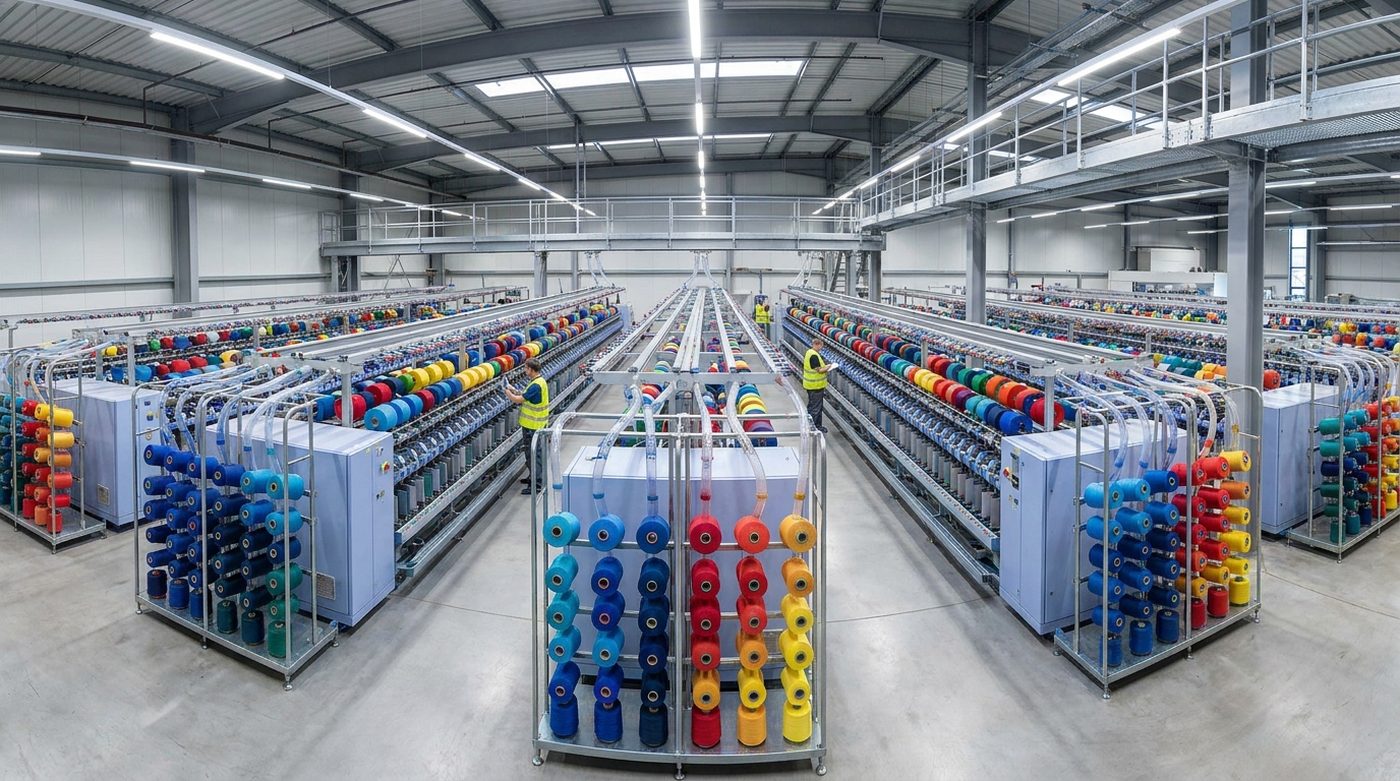
As Colorex, we have a wide range of masterbatch and special additive products that fully comply with the sensitive dynamics and high standards of the textile sector. With formulas specifically developed for various polymer types such as polypropylene, polyester, and polyamide used in synthetic yarn and fiber production, we offer solutions that provide maximum efficiency and advantage to our business partners in their production processes.
We are aware that preventing yarn breakages and machine filter clogs in textile applications depends on excellent dispersion quality. In this regard, we design products with high color fastness, washing resistance, and UV resistance for a wide range of applications from spunbond fabrics to multifilament yarns. Thanks to the Filter Pressure Value (FPV) tests we apply as a standard for each lot in our advanced laboratory, we guarantee a continuous, waste-free, and flawless production experience for textile manufacturers.
Recommended Dosage
In spunbond and nonwoven fabric applications: 1.0% - 2.5%
In multifilament and fiber production: 1.5% - 3.5%
In technical textiles requiring high UV resistance and special performance: 2.0% - 4.5%
Frequently Asked Questions and Solutions
A technical guide of 50 questions compiled from the field experience of the Colorex engineering team.
Masterbatch is causing yarn breaks during fiber spinning, what is the cause?
Pigment agglomeration (clumping) is likely blocking the spinneret holes; Colorex textile series with nanometric dispersion and a low Filter Pressure Value (FPV) should be used, and the masterbatch should be dried at 80°C.
What causes color fluctuation (streaking) in multifilament yarns?
The dosing pump is feeding irregularly; the gravimetric dosing system should be calibrated and feed homogeneity should be ensured using a concentrated masterbatch with high color strength.
Why does the spinneret clog frequently in spunbond fabric?
The particle size is large or the inorganic filler ratio is high; nonwoven series containing high-purity pigment with a sub-micron particle size should be preferred.
Why does the tenacity (breaking strength) decrease in POY/FDY yarns?
The carrier polymer is incompatible with the base polymer; a masterbatch with a PET-based carrier for polyester and a PP-based carrier for PP should be selected, and incompatible carriers should be avoided.
The color of the textile product fades after washing, what is the solution?
A pigment with low wash fastness has been used; high-performance pigment groups with high wash and rubbing fastness, suitable for polyester/polyamide, should be selected.
The color of outdoor textiles (umbrellas, awnings) fades in the sun?
The light fastness is insufficient; pigments with a value of 7-8 on the Blue Wool Scale and Colorex series with UV stabilizer additives should be used.
What causes a rough surface and fuzzing in the fiber?
The dispersion quality is low; a masterbatch produced by twin-screw extrusion with homogeneous distribution should be used and the melt filter should be checked.
What should the masterbatch dosage be in fine denier yarns?
Generally between 1.0% and 2.5%; for fine denier, highly concentrated series (giving high color at low dosage) should be preferred to prevent an increase in FPV.
The filter pressure is continuously rising during production, why?
There are coarse particles or gel formation in the masterbatch; Colorex series that have passed the FPV test in every lot should be used and the melt filter porosity should be selected appropriately.
How is color homogeneity achieved in carpet yarn (BCF)?
With highly dispersed, heat-stable pigments and correct dosage; agglomeration-free series resistant to the high temperatures of the BCF process should be used.
How is safe coloring achieved in nonwoven medical products?
A food/medical grade masterbatch containing heavy-metal-free, EU 10/2011 and REACH compliant, low-migration pigment suitable for skin contact should be selected.
What is the advantage of spin dyeing (dope dyeing)?
Water consumption and dye waste are eliminated; by adding masterbatch to the polymer melt, the fiber is colored internally, thus providing high fastness and eco-friendly production.
The whiteness (brightness) remains insufficient in PP textiles?
The TiO2 opacity or optical brightener is low; the dosage of white masterbatch with high TiO2 content or an optical brightener should be increased.
How is the problem of static electricity buildup in fiber solved?
An antistatic additive is required; the surface resistivity should be lowered by adding a permanent antistatic masterbatch to the formulation, resolving dust attraction/processing issues.
How is UV resistance increased in technical textiles (geotextiles)?
A stabilizer masterbatch containing HALS and UV absorber should be added; the outdoor lifespan is extended and photo-oxidative degradation is delayed.
How is waste reduced during color transitions (batch changes)?
A purging compound should be used; the temperature is temporarily raised by 10°C and the old pigment is removed from the barrel with a high-viscosity purging agent.
What causes yellowing in polyamide (PA6) fiber?
There is thermal degradation and oxidation; a PA-compatible masterbatch with an antioxidant additive should be used and the process temperature should be kept below 290°C.
The masterbatch is damp and creates bubbles during production?
The hygroscopic carrier has absorbed moisture; it should be dried for 4 hours at 80°C before use or stored in moisture-barrier packaging.
How is high color strength achieved at low dosage?
With a concentrated masterbatch with high pigment loading; this both reduces cost and prevents an increase in FPV and loss of mechanical properties.
How is the ideal melt temperature determined in fiber spinning?
According to the MFI compatibility of the carrier and the base polymer; melt fracture and thermal degradation should be balanced based on the range specified in the Colorex TDS.
Why is carrier selection critical in textile masterbatch?
In order to ensure rheological compatibility with the base polymer; an incompatible carrier leads to phase separation, yarn breakage, and spinneret clogging.
Why do point color defects (specks) appear in fabric?
There are contaminated or burnt particles; this is eliminated with a clean process, an appropriate melt filter, and high-purity masterbatch.
How is luster adjusted in polyester fiber?
With the TiO2 delustrant ratio; the desired sheen is achieved by selecting a masterbatch with high TiO2 for matte and low TiO2 for glossy.
How is color consistency ensured in recycled (rPET) fiber?
The variable yellowish tone of rPET should be masked; a neutral base should be obtained with a toner/bluing-additive masterbatch and the target color built on top of it.
How is an antimicrobial property imparted to fiber?
With a silver-ion-based antimicrobial masterbatch; ISO 20743 compliant series providing lasting hygiene are integrated into the fiber.
Yarn breakage increases at high spinning speed?
The melt strength is low; the line speed is maintained with narrow particle distribution, low-FPV series and optimized dosage.
What happens if the masterbatch dosage is excessive?
Mechanical strength decreases and the spinneret clogs; the upper dosage limit in the TDS should not be exceeded, and a more concentrated series should be selected if necessary.
What should the color selection be in PP sack/raffia yarn?
A UV-resistant, PP-carrier high-opacity masterbatch; high TiO2 is preferred for light colors and pigment with high light fastness for dark colors.
How is odor (especially in rPET) eliminated in fiber?
With an odor absorber masterbatch; VOC and sulfur/amine-based molecules are chemically neutralized.
What is the best UV protection in dope-dyed black fiber?
A masterbatch containing high-structure carbon black (PBk7); it provides both maximum blackness and superior UV barrier and light fastness.
How is denier consistency maintained in yarns?
With constant dosage and a homogeneous melt; gravimetric feeding and low-FPV masterbatch prevent fluctuations in cross-sectional thickness.
Why does colored masterbatch come out different from batch to batch?
The color matching tolerance is wide; Colorex production with tight CIELAB (ΔE) tolerance, where every lot is checked with a spectrophotometer, should be preferred.
How are fluorescent/neon colors achieved in textiles?
With a special fluorescent pigment masterbatch; however, since light fastness is limited, it should be used in indoor/short-life applications.
How are extruder feeding problems prevented in fiber production?
The masterbatch granule size should be compatible with the base polymer; homogeneous feeding without segregation is achieved with similar granule geometry.
Can a soft touch effect be imparted to polyolefin fiber?
With slip and special additive masterbatches; a softer hand is achieved by lowering the surface coefficient of friction.
What is the risk of color migration in non-cabled technical wovens?
It is prevented with low-migration, high-molecular-weight pigments; color bleeding into adjacent layers is blocked.
In which case is a carrier-free (universal) series used in masterbatch?
For facilities working with multiple polymers; however, in critical textiles, a series with the same carrier as the base polymer always provides higher performance.
What causes color shift with heat (non-thermochromic) in fiber?
The heat resistance of the pigment has been exceeded; a pigment suitable for the process temperature, with the heat resistance specified in the TDS, should be selected.
Why is high purity essential in fine fiber production?
Small spinneret holes clog even with the smallest impurity; premium masterbatch with high purity and low ash content is required.
What are the storage conditions for masterbatch before knitting/weaving?
A cool, dry environment out of direct sunlight; it should be stored in its original packaging to prevent moisture absorption and pigment degradation.
How is color safety ensured in PP nonwoven hygiene products?
A skin-contact-safe, heavy-metal-free, EU/FDA compliant masterbatch; it is mandatory in products such as diapers and wet wipes.
Is the electret (filtration) property in fiber affected by coloring?
The wrong additive disrupts the surface charge; an electret-compatible, non-conductive special masterbatch should be selected for filtration fibers.
Is coloring difficult in high-tenacity (industrial) yarns?
High strength must be maintained; loss of mechanical properties is minimized with a low-dosage, highly concentrated, narrow-distribution masterbatch.
Why can production differ from the color laboratory approval?
It is due to a difference in process temperature/shear force; color matching must absolutely be done under actual production conditions (with process simulation).
How is post-processing (dyeing/finishing) compatibility ensured in fiber?
So that the additives do not interact with the finishing chemicals; a post-processing-compatible, non-migrating pigment and additive system should be selected.
Why do gel particles form within the masterbatch?
It is due to excessive heat or dwell time; gel formation is prevented with a controlled extrusion temperature and a clean process, and filtration is applied.
Is sustainable (bio-based) coloring possible in textiles?
With PLA and biopolymer compatible masterbatch series; EN 13432 compliant color solutions are offered for compostable fibers.
How often should the melt filter be changed in fiber spinning?
According to the increase in FPV; the use of quality masterbatch with low FPV extends filter life and reduces downtime.
How can I reach Colorex to request a color sample?
You can apply to our laboratory with information on polymer type, denier, and target color; you can request a sample and TDS via WhatsApp or the contact form.
Who makes the correct masterbatch selection for my textile project?
Colorex sales engineers; they determine the optimum series and dosage according to the polymer, process (spunbond/multifilament), and performance requirements.
Let's find the right solution for your project
Contact our team for sample requests, color matching or technical consultancy.