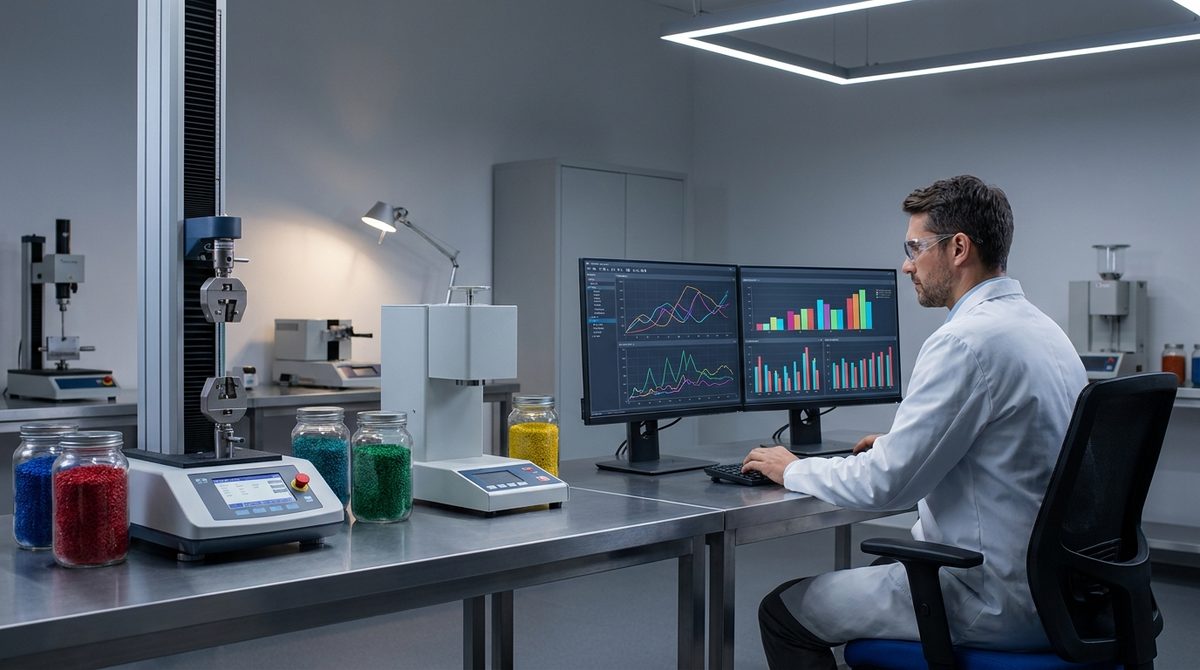
Technische Referenztabellen, zusammengestellt vom Colorex-Ingenieurteam: Polymerkompatibilität, Lichtechtheit und Migrationsechtheit sowie Abbauarten von Kunststoffen und deren Lösungen. Die Werte sind typische industrielle Referenzwerte; für die genaue Projektkompatibilität kontaktieren Sie bitte unser Labor.
Die Werte sind typische Referenzen für das Spritzgussverfahren; stützen Sie die endgültigen Einstellungen stets auf das technische Datenblatt (TDS) Ihres Rohstofflieferanten (Colorex).
Pigment-Hitzebeständigkeit und chemische Klasse (nach Farbindex)
Farbindex (C.I.)
Chemische Struktur
Klasse
Hitzebeständigkeit (°C)
Typische Farbe/Anwendung
PW6
Titandioxid
Anorganisch
300+
Weiß / deckend
PBk7
Ruß
Anorganisch
300+
Schwarz / UV
PB15:1/:3
Kupferphthalocyanin
Organisch
280–300
Blau
PG7
Phthalocyaningrün
Organisch
280–300
Grün
PR122
Chinacridon
Organisch
280–290
Magenta / Violett
PV23
Dioxazin
Organisch
260–280
Violett
PY110
Isoindolinon
Organisch
280–300
Gelb
PY83
Diarylid
Organisch
200–230
Gelb (wirtschaftlich)
PR254
DPP
Organisch
290–300
Rot
PO34
Diarylidorange
Organisch
200–230
Orange
PR101
Eisenoxidrot
Anorganisch
300+
Rotbraun
PY42
Eisenoxidgelb
Anorganisch
180–200
Gelb-Erdton
Die Hitzebeständigkeitswerte zeigen typische Obergrenzen für eine Verweilzeit von 5 Minuten. Colorex bietet technische Unterstützung bei der Auswahl hitzebeständiger Pigmente für Ihren Prozess.
Betroffene PolymereTeilkristalline Teile, PE, PP, PA
Colorex-LösungNukleiertes Masterbatch mit abgestimmter Kristallisation
🔎Optischer Abbau
SymptomeTrübung, Glanzverlust
Betroffene PolymereTransparente Verpackungen, PMMA, PC
Colorex-LösungClarifier-Masterbatch für verbesserte Transparenz
Internationale Pigment-Farbindex (C.I.)- & Standardcode-Referenz COLOREX
Weltstandard Color Index (C.I.)-Name, CAS-Nummer, C.I.-Konstitutionsnummer und wichtige Leistungswerte. Werte sind typische Industriereferenzen; das jeweilige Produkt-TDS ist maßgeblich.
C.I.-Name
C.I.-Nr.
CAS-Nr.
Chemische Struktur
Klasse
Farbe
Hitze (°C)
Lichtechtheit (BWS)
PW6
77891
13463-67-7
Titanium Dioxide (Rutile)
Anorganisch
Weiß
300+
7–8
PBk7
77266
1333-86-4
Carbon Black
Anorganisch
Schwarz
300+
7–8
PY180
21290
77804-81-0
Benzimidazolone
Organisch
Gelb
280–300
7
PY110
56280
5590-18-1
Isoindolinone
Organisch
Gelb
290–300
7–8
PY83
21108
5567-15-7
Diarylide (HR)
Organisch
Gelb
200–230
4–5
PO34
21115
15793-73-4
Diarylide Orange
Organisch
Orange
200–230
4–5
PO64
12760
72102-84-6
Benzimidazolone Orange
Organisch
Orange
280–300
7
PR254
56110
84632-65-5
DPP (Diketopyrrolopyrrole)
Organisch
Rot
290–300
7–8
PR122
73915
980-26-7
Quinacridone
Organisch
Magenta
280–290
7–8
PR101
77491
1309-37-1
Iron Oxide Red
Anorganisch
Rotbraun
300+
7–8
PR170
12475
2786-76-7
Naphthol AS
Organisch
Rot
200–230
4–6
PBr25
12510
6992-11-6
Benzimidazolone Brown
Organisch
Braun
260–280
7
PBr6
77491
52357-70-7
Iron Oxide Brown
Anorganisch
Braun
300+
7–8
PV23
51319
6358-30-1
Dioxazine
Organisch
Violett
260–280
7
PV19
73900
1047-16-1
Quinacridone Violet
Organisch
Violett
280–290
7–8
PB15:1
74160
147-14-8
Copper Phthalocyanine (α)
Organisch
Blau (rötlich)
280–300
7–8
PB15:3
74160
147-14-8
Copper Phthalocyanine (β)
Organisch
Blau (grünlich)
280–300
7–8
PB29
77007
57455-37-5
Ultramarine
Anorganisch
Blau
230–260
7–8
PG7
74260
1328-53-6
Phthalocyanine Green
Organisch
Grün (bläulich)
280–300
7–8
PG36
74265
14302-13-7
Phthalocyanine Green (Br)
Organisch
Grün (gelblich)
280–300
7–8
Abkürzungen: C.I. = Color Index; CAS = Chemical Abstracts Service; BWS = Blauwollskala (1–8). Hitzebeständigkeit und Echtheit variieren je nach Konzentration, Matrix und Farbtiefe.
Häufig gestellte Fragen und Lösungen
Ein technischer Leitfaden mit 50 Fragen, zusammengestellt aus der Praxiserfahrung des Colorex-Engineering-Teams.
Wozu dient die Polymer-Kompatibilitätsmatrix?
Sie zeigt die gemeinsame Verarbeitbarkeit/Mischbarkeit verschiedener Polymere; sie hilft, bei Blends und beim Recycling inkompatible Paarungen zu vermeiden.
Können PE und PP zusammen recycelt werden?
Sie sind begrenzt kompatibel (teilweise); ohne Verträglichkeitsvermittler sinken die mechanischen Eigenschaften, weshalb in der Matrix hierfür eine mittlere Verträglichkeit angegeben wird.
Was passiert, wenn inkompatible Polymere gemischt werden?
Es kommt zu Phasentrennung, schwacher Grenzfläche und geringer mechanischer Festigkeit; ein Verträglichkeitsvermittler oder eine getrennte Verarbeitung ist erforderlich.
Was zeigt die Tabelle der Schmelztemperatur (Tm)?
Die Temperatur, bei der die kristallinen Bereiche teilkristalliner Polymere schmelzen; sie bildet die Grundlage für die Prozess- und die Auswahl der Hitzebeständigkeit von Pigmenten.
Warum ist die Glasübergangstemperatur (Tg) in der Tabelle wichtig?
Sie ist ein Indikator für das amorphe Verhalten und das Risiko der Pigmentmigration; bei Polymeren mit niedriger Tg ist das Migrationsrisiko hoch.
Warum muss die Polymerdichte bekannt sein?
Für Teilegewicht, Füllstoffberechnung und Kosten; außerdem ist sie beim auf Schwimm-/Trennverfahren basierenden Recycling entscheidend.
Wofür wird die Verarbeitungstemperaturtabelle verwendet?
Sie gibt für jedes Polymer den typischen Schmelz- und Werkzeugtemperaturbereich an; sie dient als Referenz für die Grundeinstellungen.
Warum sind die Tabellenwerte nur Referenzwerte?
Sie variieren je nach Grade und Anwendung; für die endgültige Einstellung ist stets das TDS Ihres Rohstofflieferanten (Colorex) maßgeblich.
Was ist die typische Verarbeitungstemperatur von PP?
Schmelze etwa 200-280°C, Werkzeug 30-80°C; sie wird je nach Grade und Bauteilgeometrie optimiert.
Warum erfordert PC eine hohe Verarbeitungstemperatur?
Aufgrund der amorphen Struktur mit hoher Tg; die Schmelze wird bei etwa 280-320°C und das Werkzeug bei etwa 85-120°C verarbeitet.
Wie ist die Verarbeitungstemperatur von PET?
Schmelze etwa 260-280°C, Werkzeug 20-30°C; da es Feuchtigkeit aufnimmt, ist eine Trocknung vor der Produktion unerlässlich.
Was zeigt die Lichtechtheitstabelle (BWS)?
Die Lichtechtheitswerte der Pigmentklassen auf der Blauwollskala (1-8); sie bestimmt die Eignung für den Außen-/Innenbereich.
Was liefert die Migrationsechtheitstabelle (Graumaßstab)?
Das Pigmentmigrationsrisiko (1-5) je nach Polymer/Umgebung; sie leitet die Pigmentauswahl bei Lebensmittel- und empfindlichen Anwendungen.
Wofür dient die Tabelle der Pigment-Hitzebeständigkeit?
Sie gibt die maximale Temperatur an, der das Pigment gemäß Farbindex standhält; für die Auswahl eines zur Prozesstemperatur passenden Pigments.
Warum ist die Farbindex-Tabelle (C.I.) nützlich?
Sie klassifiziert Pigmente mit einem Standardcode (PW6, PBk7, PB15 usw.); sie ermöglicht eine zuverlässige und reproduzierbare Auswahl.
Was vergleicht die Pigmentspektrum-Tabelle?
Sie zeigt die Unterschiede zwischen anorganischen und organischen Pigmenten hinsichtlich Herkunft, Farbstärke, Opazität, Echtheit und Kosten.
Wozu dient die Tabelle der Wellenlängen des sichtbaren Lichts?
Sie gibt die Wellenlängenbereiche (nm) an, denen die Farben entsprechen; sie wird zum Verständnis der Farb-Spektrum-Beziehung verwendet.
Mit welchen Vorteilen zeichnet sich das anorganische Pigment in der Tabelle aus?
Hohe Hitze-/Lichtechtheit, Opazität sowie chemische/thermische Beständigkeit; matte Farben und wirtschaftliche Kosten.
Mit welchen Vorteilen zeichnet sich das organische Pigment in der Tabelle aus?
Hohe Farbintensität, lebendige/leuchtende Farben und Transparenz; die Echtheit ist jedoch variabel und die Kosten können höher sein.
Was bedeutet die Verwendung 'Innen + Außen' in der Tabelle?
Dass das Pigment eine für sowohl Innen- als auch Außenbereich geeignete Lichtechtheit (7-8) besitzt; es kann im Außenbereich sicher verwendet werden.
Was bedeutet die Kennzeichnung 'Nur Innen'?
Sie zeigt an, dass das Pigment aufgrund geringer Lichtechtheit nur für Innenbereich-/kurzlebige Anwendungen geeignet ist.
Wie wird die Dichtetabelle beim Recycling verwendet?
Bei der Schwimm-Sink-Trennung (Float-Sink); durch den Dichteunterschied werden die Polymere voneinander getrennt.
Warum hat TiO2 (PW6) in der Tabelle die höchste Deckkraft?
Dank des hohen Brechungsindex; es liefert bei niedriger Dosierung absolute Opazität und Weiße.
Auf welchen Standards beruhen die Tabellendaten?
Lichtechtheit ISO/ASTM, Migration DIN 53775; die Werte werden unter standardisierten Testbedingungen ermittelt.
Warum sind PA6 und PA66 in der Tabelle unterschiedlich?
Sie haben unterschiedliche Schmelztemperaturen (PA6 ~220°C, PA66 ~260°C) und Verarbeitungsbereiche; dies beeinflusst die Grade-Auswahl.
Warum zeigen amorphe Polymere in der Tabelle kein Tm?
Da sie keine kristallinen Bereiche enthalten, haben sie keine Schmelztemperatur; sie werden nur durch Tg (Glasübergang) charakterisiert.
Wie erleichtert die Tabelle die Pigmentauswahl?
Sie zeigt Hitzebeständigkeit, Echtheit und chemische Klasse gemeinsam; das für die Anwendung geeignete Pigment lässt sich schnell bestimmen.
Warum ist Weich-PVC in der Migrationstabelle mit hohem Risiko behaftet?
Der Weichmacher erhöht das freie Volumen; die Pigmentdiffusion wird erleichtert und die Migration (Grad 2-3) steigt.
Warum ersetzt die Tabelle nicht das Colorex-TDS?
Sie ist eine allgemeine Referenz; für spezifischen Grade, Dosierung und Prozess ist das technische Datenblatt von Colorex maßgeblich.
Warum ist Diarylidgelb in der Lichtechtheitstabelle niedrig?
PY83 hat eine hohe Farbintensität, aber eine geringe Lichtechtheit (3-4); daher ist es nur für den Innenbereich geeignet.
Warum hat Phthalocyanin in der Tabelle eine hohe Echtheit?
PB15/PG7 bietet mit seiner stabilen organischen Struktur eine Lichtechtheit von 7-8; es kann sicher, auch im Außenbereich, verwendet werden.
Warum enthält die Verarbeitungstemperaturtabelle die Werkzeugtemperatur?
Die Werkzeugtemperatur bestimmt Morphologie, Oberflächenqualität und Schwindung; sie muss gemeinsam mit der Schmelze optimiert werden.
Warum wird PVC laut Tabelle bei niedriger Temperatur verarbeitet?
Da es hitzeempfindlich ist; bei hoher Temperatur setzt es HCl frei und zersetzt sich, daher wird es im Bereich 160-210°C verarbeitet.
Worauf beziehen sich die 5 Minuten der Pigment-Hitzebeständigkeit?
Es ist die Obergrenze für die typische Verweilzeit; da der Wert bei längerer Dauer sinken kann, muss die Prozesszeit berücksichtigt werden.
Was ist der Sicherheitshinweis zu anorganischen Pigmenten in der Tabelle?
Einige auf Schwermetallen basierende anorganische Pigmente können gefährlich sein; bei Lebensmittel-/empfindlichen Anwendungen sollte eine schwermetallfreie Alternative gewählt werden.
Wie ist das Sicherheitsprofil organischer Pigmente in der Tabelle?
Sie sind in der Regel sicher und stabil; für die spezifische Anwendung sollte jedoch die Regulierungskonformität (REACH/FDA) überprüft werden.
Schwimmen Polymere mit niedriger Dichte (PP/PE) im Wasser?
Ja; ihre Dichte liegt unter 1 g/cm³ (PP ~0,90), daher schwimmen sie im Wasser und werden bei der Trennung genutzt.
Welches Polymer ist in der Tabelle am dichtesten?
In der Regel PVC und POM (~1,4 g/cm³) sowie gefüllte Grades; eine hohe Dichte erhöht das Teilegewicht.
In welchem Bereich liegt Rot in der Farb-Wellenlängen-Tabelle?
Etwa 700-635 nm; es ist der Bereich des sichtbaren Lichts mit der längsten Wellenlänge.
In welchem Wellenlängenbereich liegen Blau/Violett?
Blau ~490-450 nm, Violett ~450-400 nm; es ist der Bereich des sichtbaren Lichts mit der kürzesten Wellenlänge.
Wie schlagen sich die Tabellendaten im Produktdesign nieder?
Indem Polymer, Prozesstemperatur, Pigmentechtheit und Migration von Anfang an aufeinander abgestimmt gewählt werden; so entsteht ein einwandfreies und langlebiges Produkt.
Was passiert, wenn die Verarbeitungstemperatur überschritten wird?
Thermische Zersetzung, Farbverlust und mechanische Schwäche; der Tabellenbereich und die Pigment-Hitzebeständigkeit müssen gemeinsam beachtet werden.
Wie wird die Kompatibilitätsmatrix bei Schichtprodukten verwendet?
Zur Bewertung der Haftung/Verträglichkeit der Polymere benachbarter Schichten; bei inkompatiblen Paarungen ist eine Haftvermittlerschicht erforderlich.
Wie hilft die Tabelle bei der Recyclingplanung?
Mit Dichte- und Kompatibilitätsdaten; durch die Bestimmung trennbarer und gemeinsam verarbeitbarer Polymere wird die rPCR-Qualität gesteigert.
Wie beeinflusst die Wahl der Pigmentklasse die Kosten?
Anorganische sind wirtschaftlich, hochleistungsfähige organische sind teuer; mit der Tabelle wird das Gleichgewicht zwischen Leistung und Kosten hergestellt.
Was bedeutet die chemische/thermische Beständigkeit in der Tabelle?
Die Beständigkeit des Pigments gegenüber Säure/Base/Lösungsmittel und Hitze; sie bestimmt die Pigmentauswahl bei anspruchsvollen Umgebungsanwendungen.
Wie oft werden diese Tabellen aktualisiert?
Colorex aktualisiert die technischen Tabellen regelmäßig entsprechend den Entwicklungen im Produktsortiment und in den Standards.
Was soll ich für einen Wert tun, den ich in den Tabellen nicht finde?
Sie können sich an das Colorex-Labor wenden; dort können Sie für ein spezifisches Polymer, Pigment oder einen Prozess detaillierte technische Daten und das TDS anfordern.
Wie wende ich die technischen Tabellendaten in der Produktion an?
Indem Sie sie als Referenz nehmen und mit den Colorex-Ingenieuren verifizieren; die für Ihre Anwendung spezifische Dosierung, Temperatur und Pigmentauswahl wird geklärt.
Wen konsultiert man für die richtigen technischen Werte?
Die Colorex-F&E- und Vertriebsingenieure; sie liefern je nach Polymer-, Prozess- und Leistungsanforderung die richtigen Tabellendaten und die Rezeptur.
Lassen Sie uns die passende Lösung für Ihr Projekt finden
Kontaktieren Sie unser Team für Musteranfragen, Farbabstimmung oder technische Beratung.